Selected works
Ferris Wheel
, 2025, C-print & color ink,
133 × 125 cm
Lantern Festival
, 2025, C-print & color ink, 128 × 125 cm

Lantern Festival, a small town in the Central Plains. In daylight, diverse lanterns become sculptures, awaiting night-time visitors.
Ribbon
, 2026, C-print & color ink, 128 × 125 cm
Spring Festival. Colourful streamers adorn the gateways of Xiyuan Park. People pass by, voices light with joy. Wind rises, and the ribbons dance.
Garden II
, 2024, C-print & color ink,
165×150cm
Garden I
, 2024, C-print & color ink, 150×165cm
America. Plants overgrow in a California park, unruly and rampant, like plastic flowers waiting for sale at hometown festivals.
Fireworks I
, 2025, C-print & color ink,
152×150cm
Fireworks II
, 2025, C-print & color ink,
157×150cm
California’s flora resembles
fireworks. They ascend, detonate, and roar. We gaze at the celestial radiance, blind to how the harsh light colours
the whole world uniformly.
Dance
, 2026, C-print & color ink,
176×124cm
On weekends, beneath this sculpture in the city centre park, elders gather to play chess while children run about. Day after day, year after year.
Bridge
, 2026, C-print & color ink,145×126cm
Water Activities, 2026, C-print & color ink,126 × 126 cm
Drum, 2026, C-print & color ink,126×135cm
Stone bridge reflection mirrors the park’s bustle. A tired child rests in a water walking ball. Deafening drumbeats have ceased. Brief calm settles after the uproar. Stillness builds, ready for the next commotion.
Fire Ritual
, 2026, C-print & color ink,129 × 125 cm
Deep in the Greater Khingan
Mountains. Every June 18, the Oroqen gather
for a grand festival, honouring the
fire god. A massive bonfire crackles in the
square, as though the fire god has
arrived. Flames twist upward. At that instant, fire lives.
Meat
, 2026, C-print & color ink,130×125cm
On market days in the village. Crowds cluster around the meat
stall, hunting for perfectly marbled,
immaculate cuts.
Basket
, 2026, C-print & color ink,126×126cm
Bamboo baskets for sale at the market remind me of my grandmother. As a child, I would watch her sit quietly in the corner, weaving small baskets to earn a living.
Boat Ride II
, 2026, C-print & color ink,153×126cm
Boat Ride I
, 2026, C-print & color ink,153×126cm
Boat Ride III
, 2026, C-print & color ink,153×126cm
People row small boats, lost in
delight. This joy ought not to be disturbed.
Anutpada & Amrta
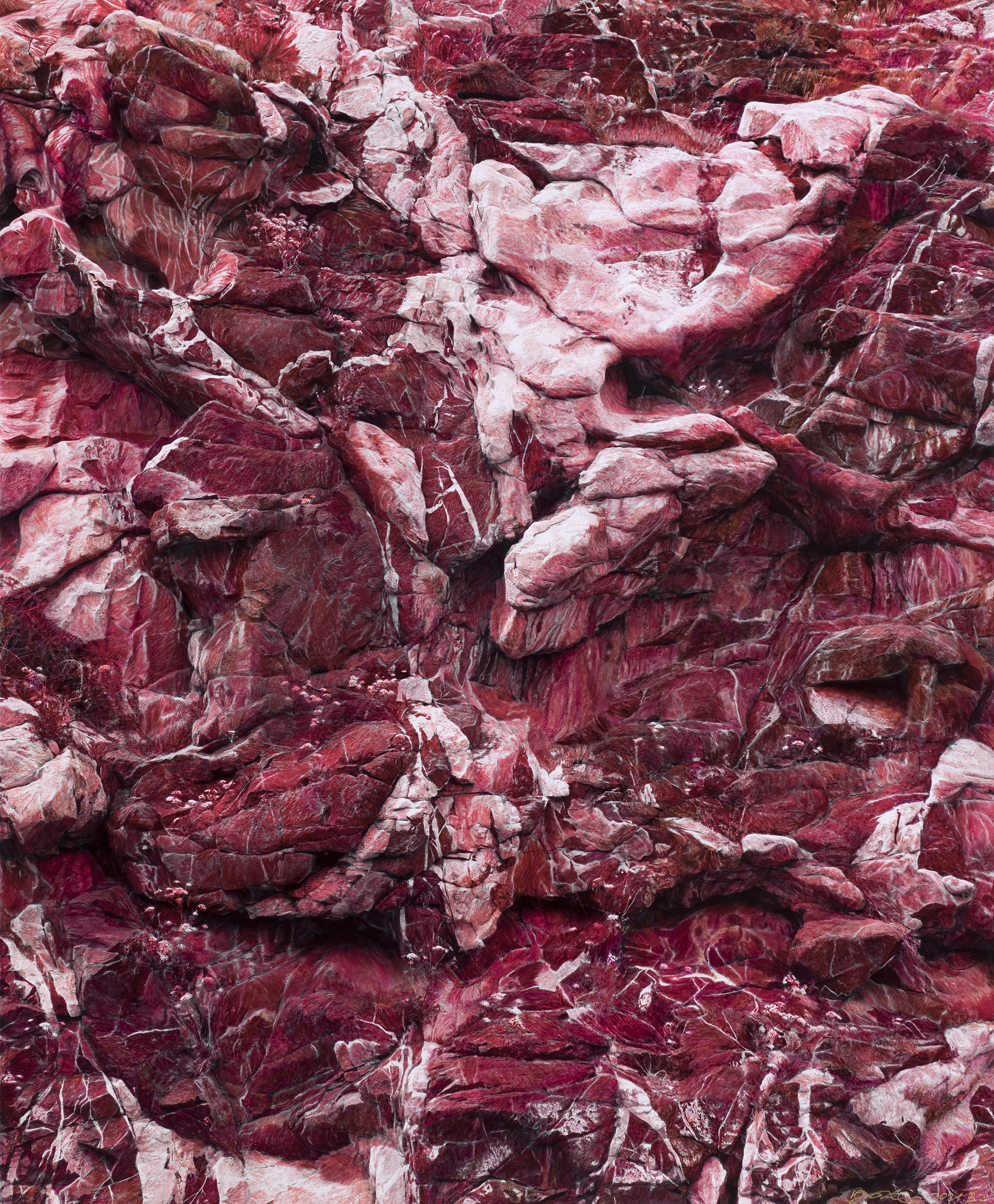
The artist stood among stones in the wilderness. Light shifted. Wind rose and fell. After a long gaze, those ordinary stones began to breathe—great bodies heaving like bellies, their smooth folds turning into skin. Alive? Dead? The distinction began to blur.
The image is out of focus. Not a flaw in your eyes, but a deliberate act. Step closer. Beneath the “skin,” veins emerge, brushstroke by brushstroke—dark red vessels that carry the qi of the entire picture. Unreality, the artist insists, is not untruth. Vagueness is the condition of aliveness.
So here are two images, side by side. On the left: warm, swollen, lush. The stones seem about to sit up, to stand—life at its most ravenous and fervent. On the right: cold, clenched, muscles frozen beneath dark red veins, asleep but waiting for the next awakening.
Same stones. Two faces of one thing. Through them, the artist speaks an ancient recognition: Anutpada — no birth, things never truly came into being; Amrta — deathless, beyond the fear of death. The living walk toward death each day. Death is merely life’s other form. The two are one—a turning without end.

Time is the container of reality. "Scene A B" is a diptych of images recorded in a mountain area in California, USA. At that time, I had an inexplicable feeling about this area, so I recorded it and enlarged it. But I have been hesitant to do so. Due to the long period of time, the memory gradually faded. For several times, I was still at a loss when facing the image. Until I returned from the Great Khingan region. I participated in a residency program to investigate the living condition of Ewenki ethnic group in the Great Khingan region in the northeastern part of China. Many things touched me during the trip. When I came back and faced the picture again, I had the impulse to create. I made a disorderly and unconventional division of the picture, filling the overexposed rock surface with the flowing blue color, depicting the trees and rocks with blood red color, replacing the original moss with reindeer fur, and covering the original rock surface with animal guts....... Finally, I got a cruel, illusory, and disorganized scene. Like the forgotten tribe, they live in the crack of an intricate modern society, and they will be endlessly stretched, squeezed, and changed .....
The work stems from my experiences and emotions during a study tour. The somewhat abstract imagery originates from a real scene: the earth walls in the Gobi Desert of northwest China, which have been shaped over thousands of years by sedimentation and erosion. These formations resemble slices of history, encapsulating countless narratives. As I examined the textures of these surfaces, I gradually perceived what seemed to be an image of a Buddhist kingdom, possibly an illusion induced by the wind sweeping past me. Nonetheless, I instinctively captured the moment with my camera. Upon returning to my studio in Beijing and examining the enlarged photograph, the Buddhist imagery reappeared. Guided by this perception, I began to paint, gradually rendering the mysterious energy in hues of purple and orange. Through a prolonged and meticulous painting process, the artwork progressively developed a religious ambiance that resonates with my initial impressions. The completion of the piece feels like a form of redemption to me. Although I interact with the painting daily, at the end of each day, as I gaze back at the image on the easel, I find myself unable to fully bridge the gap between the external representation and the inner essence it evokes.
I attempted to depict a scene that is both real and illusory. As evident to all, this is an intricate forest that physically exists, captured through a camera lens, yet stripped of all color, retaining only fundamental tones and outlines. This monochromatic imprint of reality, which I term the “foundational layer,” serves as the basis for all my emotions and resembles a canvas. Upon this base, through the act of painting, I infuse pigments and brushstrokes that channel my emotions and experiences. This constitutes an expression of my cognitive approach to phenomena, a manifestation of my worldview, where every outcome emerges as a subjective expression grounded in an objective existence.
In the autumn of northwestern China, it is common to observe clusters of shrubs scattered across barren fields. Their withered yellow hues evoke an appearance of desolation, yet amidst the ceaseless winds of day and night, clumps of white catkins cling precariously to the branches, bending them under their weight like snow-laden boughs. This is a familiar sight in the northwest. It is precisely these seemingly ordinary plants that reveal to me the resilience of life. In such a harsh environment, trees tenaciously anchor their roots deep into the soil to resist being uprooted by the wind, while their seeds are carried aloft by the breeze, nestled within dry branches, awaiting the opportune moment to settle and take root. They support one another in their struggle for survival. Thus, I captured this scene through my camera lens and later rendered it on canvas with my brush —green symbolizing vitality, red capturing the intricate pulse of life—and carefully preserved those snow-white, soft catkins, which not only encase their seeds but also embody hope.
Wool The nature of Altay region of Xinjiang is beautiful in summer. However, I did not want to pay too much attention to the scenery because it was too beautiful, just like a piece of sweet but cloying candy, which only has a sweet taste in the mouth, but at the same time being monotonous and even a bit disappointing. I vaguely felt that there must be something more touching to me hidden under this beautiful appearance. Until one day I saw the wool of shepherds, or more precisely it should be piles of wool. That was shepherds’ main source of livelihood. They bundled up wool that they had shaved and stacked it on top of each other in large piles, waiting for vendors to come and collect. Those piles of wool were like silent tombstones in the meadow. These sad piles of wool left a deep unease in my heart. I have no way to explain why I felt that way, but I did feel the sad shiver. Therefore, I photographed those wool piles. Then I displayed this work "Wool" as a monument. Its size must be big enough to show that kind of aura. The inscription is these wools, the furs that previously had a life. I have to paint the wools one by one. The work is a monument composed of wool.